Lowry’s wider world comes into view at MK Gallery
A major retrospective opens in Milton Keynes, bringing the painter’s portraits, seascapes and early studies into the company of his familiar industrial crowds.
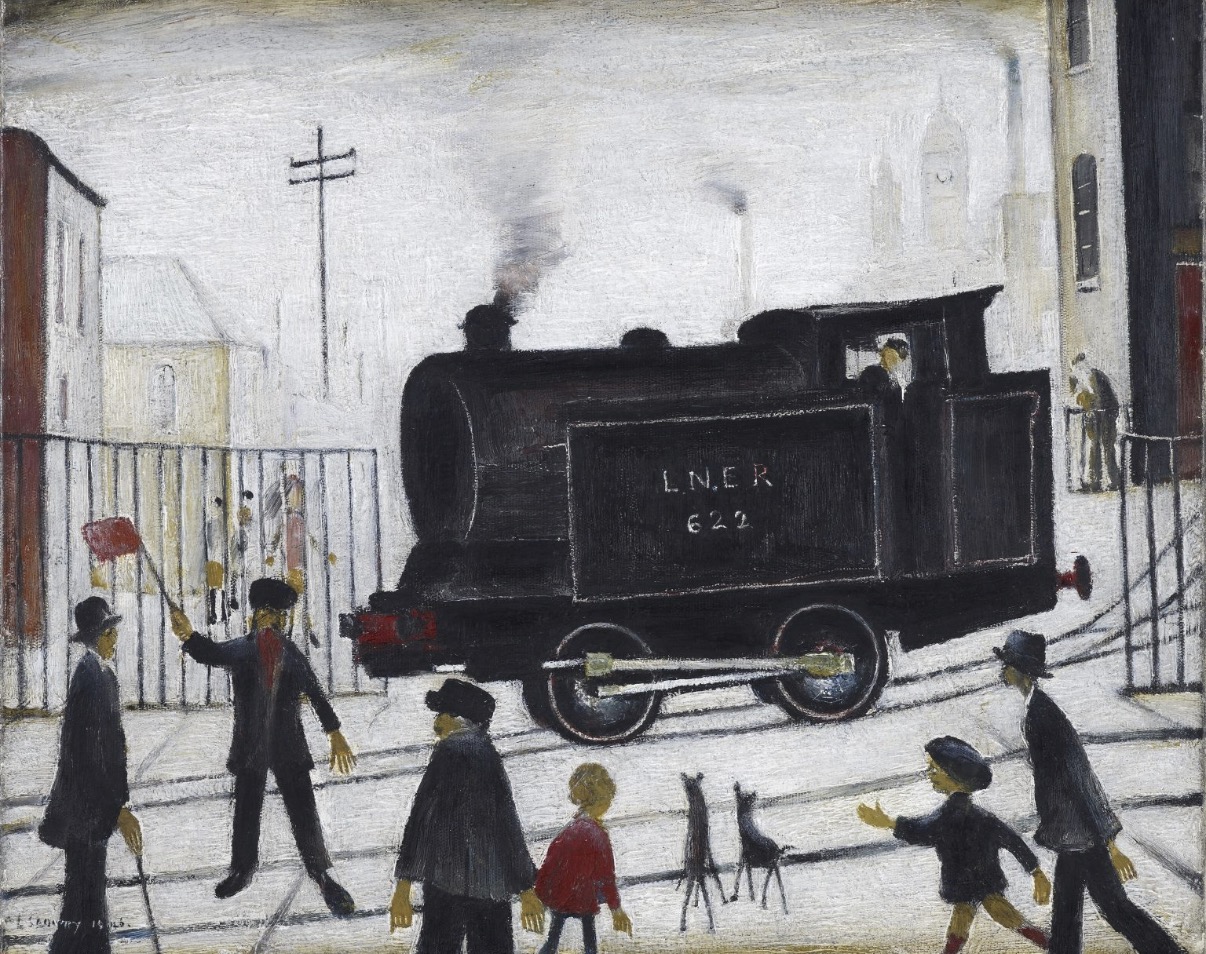
L.S. Lowry’s factories and their streams of workers have become so familiar that much of his painting can still come as a surprise. At MK Gallery, a retrospective opening on 24 October follows him from the discipline of the life room to the empty expanses of his seascapes, taking in portraits and stranger, more private inventions along the way.
Marking the fiftieth anniversary of his death, L.S. Lowry: The Theatre of Life brings together more than 140 paintings and drawings, with loans from The Lowry, Tate, the Royal Academy and private collections. It is the most substantial institutional survey since Tate Britain’s exhibition in 2013, and runs until 28 February.
Lowry’s reputation as an untutored original has proved remarkably durable for someone who spent years at art school. He attended classes in Manchester and Salford while working, and kept his job as a rent collector until his retirement in 1952.
Around 1915, his tutor Bernard Taylor encouraged him to lighten his paintings. The white ground that followed gave his dark figures their particular clarity. With a restricted palette of black, white, vermilion, Prussian blue and yellow ochre, Lowry developed a pictorial language capable of accommodating an extraordinary number of small incidents.
Those streets were assembled as much as observed. His work took him through Manchester, supplying encounters and details that could be rearranged later in the studio. Memory and invention helped to produce the composite towns that now seem so convincing as records of a vanished industrial world. The exhibition places them within a career that witnessed wartime destruction, clearance and redevelopment.
The shift from these busy scenes to the seascapes is considerable. Late examples approach abstraction, leaving little of the human activity that made his name. The portraits of Ann introduce another uncertainty. Painted in the 1950s, they show a pale, dark-haired woman whose identity remains unresolved. Lowry supplied incompatible accounts of her, allowing biography and invention to become entangled.
Lowry kept his life and art carefully apart, and helped to cultivate the stories that grew around him. The crowds, the vacant sea and the elusive woman offer different ways into a painter who made himself so readily recognisable and so difficult to pin down.
L.S. Lowry: The Theatre of Life, MK Gallery, Milton Keynes, 24 October 2026 - 28 February 2027. The accompanying catalogue, edited by Fay Blanchard and Anthony Spira, was published by Philip Wilson Publishers on 22 October: 224 pages, £25.