Beyond the Great Wave: Hokusai’s Complete Thirty-Six Views of Mount Fuji Opens at Dulwich
Dulwich Picture Gallery brings together all 46 prints from Katsushika Hokusai’s celebrated series for the first time in Britain, including exceptional impressions of The Great Wave and the rarely seen Blue Fuji.
Dulwich Picture Gallery opens a major exhibition today, 20 October, devoted to one of the most influential achievements in the history of printmaking: Katsushika Hokusai’s Thirty-Six Views of Mount Fuji. Drawn from the Iuchi Collection in Japan, the exhibition presents the complete series together in Britain for the first time, offering an opportunity to appreciate the extraordinary invention of an artist whose work helped transform the course of both Japanese and European art.
Created between approximately 1830 and 1833, when Hokusai (1760-1849) was already in his seventies, the series comprises not 36 but 46 designs. Its initial commercial success encouraged the publisher, Nishimuraya Yohachi, to commission ten additional views, extending a project that had already established a new standard for Japanese landscape printmaking.
At its centre is Mount Fuji, Japan’s highest and most sacred mountain, seen from an astonishing variety of perspectives. Sometimes it dominates the composition, rising majestically above the surrounding landscape. Elsewhere it is reduced to a distant silhouette, glimpsed through bridges, behind buildings or beyond the busy activities of everyday life.
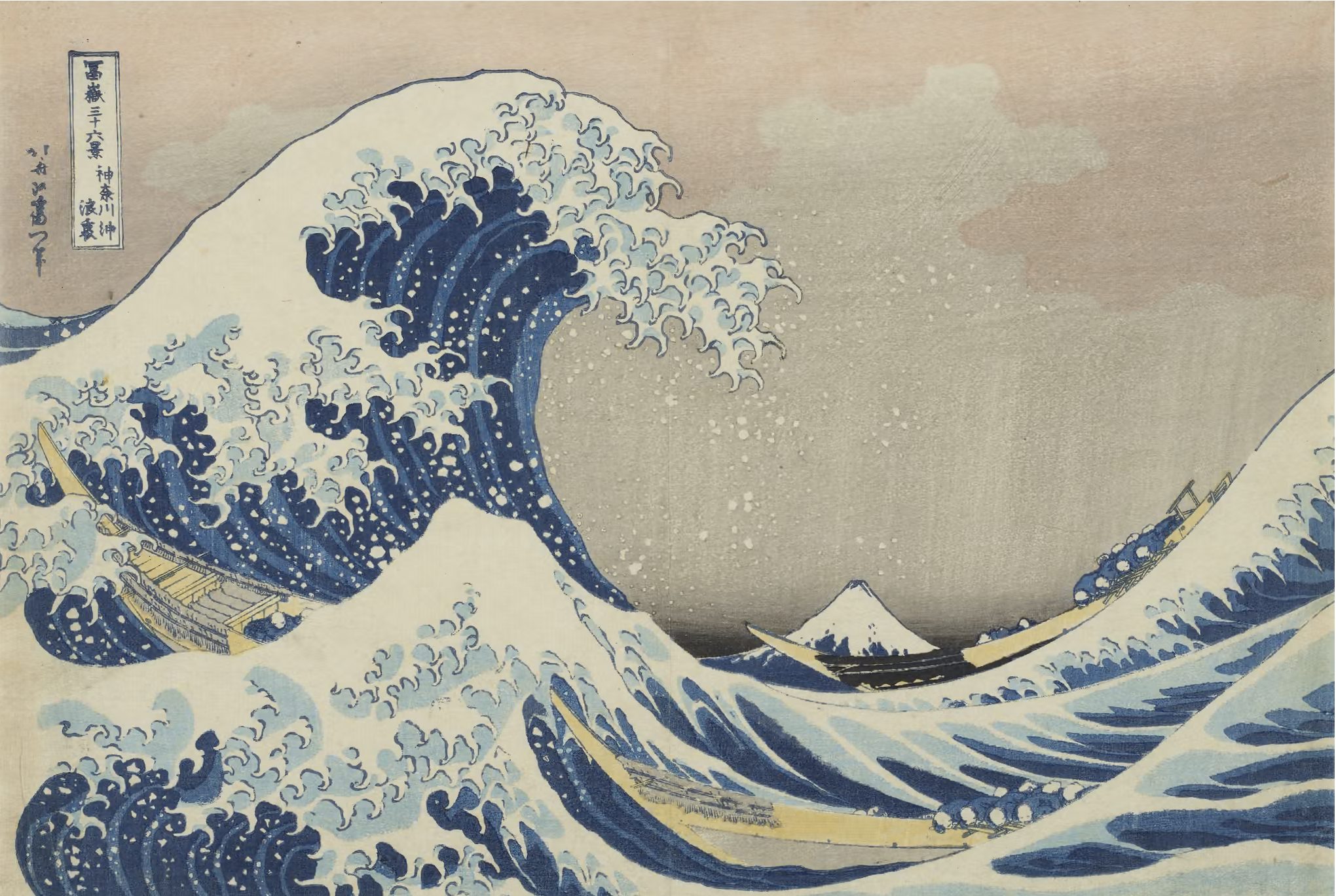
The best-known image, Under the Wave off Kanagawa, universally recognised as The Great Wave, is among the exhibition’s principal attractions. Yet the opportunity to see the entire sequence reveals just how misleading it can be to judge Hokusai’s achievement through this single, endlessly reproduced composition.
In The Great Wave, the enormous curling mass of water threatens to overwhelm three narrow boats, while Mount Fuji sits almost inconspicuously on the horizon. The apparent similarity between the wave’s triangular form and the mountain beyond is central to the composition. Hokusai makes the transient movement of water appear monumental while diminishing the actual mountain almost to insignificance.
Other prints are equally inventive. In Ejiri in Suruga Province, a sudden gust sends sheets of paper flying into the air as travellers struggle against the wind. In Fuji from Kanaya on the Tōkaidō Highway, figures are carried precariously across a turbulent river. Such works demonstrate Hokusai’s remarkable ability to animate landscape through the activities of ordinary people.
Rare impressions from the Iuchi Collection
The exhibition is made possible through the Iuchi Collection, which has been on deposit at the National Museum of Western Art in Tokyo since 2024. The collection includes particularly fine impressions of the series, several distinguished by the clarity of their printing and the preservation of their original colours.
Among the highlights is an exceptionally well-preserved impression of The Great Wave, together with a rare variation of Clear Day with a Southern Breeze, popularly known as Red Fuji.
The latter, showing the mountain glowing reddish brown beneath a patterned blue sky, is among Hokusai’s most celebrated compositions. The exhibition also includes the much rarer Blue Fuji, a predominantly blue impression of the same design, making its first appearance in Britain.
These variations offer a reminder that Japanese woodblock prints were not unique works in the manner of paintings, but products of a sophisticated collaborative process involving the artist, woodblock cutters, printers and publishers. Different impressions could exhibit considerable variations in colour, registration and detail, while the condition of the printing blocks and the survival of delicate pigments could materially affect their appearance.
One of the most important innovations of the Thirty-Six Views was Hokusai’s extensive use of Prussian blue, a European synthetic pigment that had become increasingly available in Japan. Its intense colour, together with the artist’s extraordinary manipulation of perspective and composition, gave the prints an unprecedented visual character.
The original 36 designs were distinguished by their blue outlines, while the ten subsequently added views generally employed black key-block printing. Their inclusion at Dulwich allows visitors to examine the development of the series as both an artistic undertaking and a highly successful commercial publication.
An influence far beyond Japan
The importance of Hokusai’s achievement extends well beyond the history of Japanese art. His compositions were among the works that captivated European artists during the nineteenth-century enthusiasm for Japanese prints, commonly described as Japonisme.
Claude Monet, Vincent van Gogh and James McNeill Whistler were among those profoundly interested in Japanese printmaking. Hokusai’s radical cropping, unconventional viewpoints and striking arrangements of colour and form offered an alternative to established European conventions of pictorial composition.
His repeated treatment of Mount Fuji also invites comparison with the later investigations of a single motif by European painters, notably Monet’s sequences of haystacks and Rouen Cathedral and Paul Cézanne’s paintings of Mont Sainte-Victoire.
Such comparisons should not obscure the distinct cultural and spiritual significance of Mount Fuji in Japan. For Hokusai, the mountain was much more than a convenient landscape subject. Its recurring presence connects otherwise disparate episodes of travel, labour and changing weather, providing a visual continuity throughout the series.
The exhibition consequently offers something considerably richer than an encounter with a handful of familiar masterpieces. Seen together, the prints reveal an artist of extraordinary curiosity and imagination, equally attentive to the smallest incidents of daily life and to the immense natural forms surrounding them.
Almost two centuries after their creation, Hokusai’s prints retain a startling freshness. Their graphic simplicity and extraordinary compositional intelligence continue to resonate in photography, illustration and contemporary visual culture. The Dulwich exhibition provides a rare opportunity to return to the original works and appreciate the subtlety, craftsmanship and inventiveness that reproductions can only partially convey.
Hokusai: Thirty-Six Views of Mount Fuji from the Iuchi Collection is at Dulwich Picture Gallery, London, from 20 October 2026 to 17 January 2027.