Researchers propose Caravaggio and Minniti attribution for Archimedes
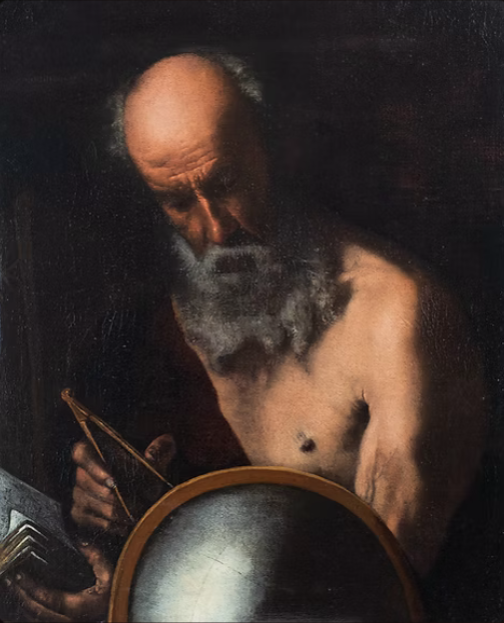
Another day, another dubious Caravaggio attribution. Researchers have proposed that a privately owned painting of Archimedes was begun by Caravaggio and completed by his associate Mario Minniti. The case was presented at a symposium in Monaco on 16 May 2026, with the researchers dating the 75 × 61cm oil on canvas to 1608-1610.
The investigation was led by Roberta Lapucci, a conservation specialist at Florence’s Istituto Lorenzo de’ Medici. According to the organisers’ account, Fabio Scaletti and Barbara Savina also presented findings and historical context, while Alessandra Gregori moderated the event. Lapucci attributes the painting’s initial design and early paint layers to Caravaggio, with its completion assigned to Minniti.
The project’s website says the picture re-emerged in 2023 after more than forty years in a private collection. It describes several phases of painting and subsequent intervention, rather than a composition preserved unchanged from its first execution.
In a press release issued on 22 June, the team cited X-rays, infrared and ultraviolet imaging, hyperspectral examination and pigment analysis in support of its conclusions. Researchers report earlier paint layers, concealed numerical markings and traces of a composition involving Medusa. They interpret these features as evidence connecting the painting with Caravaggio’s working methods.
The investigation also included artificial intelligence-assisted image analysis by Hassan Ugail of the University of Bradford, according to the project’s website. It presents this as one component of the evidence, alongside technical examination and art-historical assessment.
A further claim concerns the original subject. The researchers propose that the canvas first depicted Philip de Wignacourt before being transformed into Archimedes. They suggest the change may relate to Caravaggio’s encounter with the Sicilian scholar Vincenzo Mirabella, whose interest in the ancient mathematician could have prompted the revised subject.
The visible composition includes a compass and convex mirror. Lapucci connects these attributes with Archimedes’ association with Syracuse and her research into Caravaggio’s possible use of optical devices. This forms part of the proposed interpretation, rather than independent confirmation of the painter’s identity.
The suggested dating places the picture within Caravaggio’s final years. Having left Rome in 1606 after killing a man, he travelled to Naples and Malta, where he was imprisoned following another altercation. He escaped and subsequently worked in Sicily before returning to Naples. He died in 1610. The proposed attribution therefore concerns a period of considerable upheaval and movement in his career.
The announcement nevertheless requires careful qualification. The June release presents the attribution as resolved, but provides neither a complete provenance nor responses from specialists outside the project. Its certainty should not be confused with demonstrated scholarly consensus.
The central question is not simply whether the canvas contains an earlier composition, but who painted each stage. Establishing that distinction would require scrutiny of the underlying images, comparative evidence and the proposed division between Caravaggio’s contribution and Minniti’s. For now, Archimedes is best reported as a proposed attribution, not an undisputed addition to Caravaggio’s work.
In reality, probably best reported as Neapolitan follower of Caravaggio - circle of Paolo Domenico Finoglia.....