Karl Weschke and the other story of St Ives
A forthcoming book by Matt Retallick revisits the German-born painter’s place in Cornwall, with new research on Peter Lanyon’s art school and Francis Bacon.
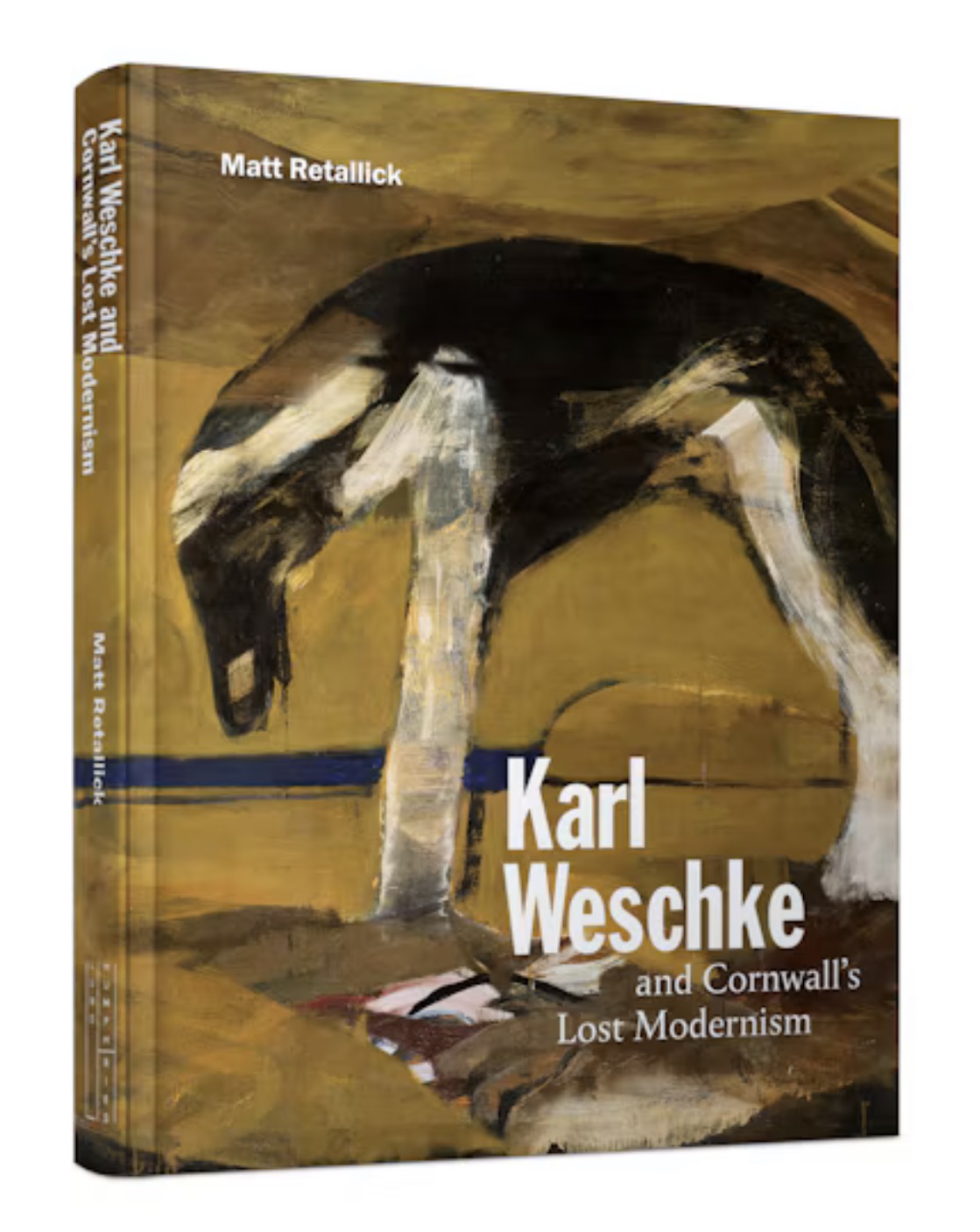
Karl Weschke belonged to the artistic world of St Ives without ever fitting comfortably into its familiar history. A friend of Peter Lanyon and Bryan Wynter, he painted bodies exposed to inhospitable landscapes and scenes shadowed by violence. A forthcoming study by Matt Retallick makes this uneasy presence the starting point for a fresh account of Cornish modernism.
Karl Weschke and Cornwall’s Lost Modernism will be published by Lund Humphries in March 2027, with a foreword by Michael Bird. Its scope extends beyond the painter’s biography to the friendships, teaching and European connections that helped shape the artistic community around him.
Weschke arrived in Britain in 1945 as a German prisoner of war. He began making art in the camps and stayed after his release. In 1955, Wynter helped him find cottages near Zennor; in 1960, he moved to Cape Cornwall, where the Atlantic became a recurring presence in his work.
That landscape could be brutally personal. A diving accident in 1977 left him helpless on the shore and prompted Body on the Beach and Caliban. The coast in these paintings is a place where a body struggles to survive. Weschke’s Cornwall was capable of swallowing its inhabitants.
Retallick, a Cornish-born art historian and curator, has been tracing the German connections behind this work. In a lecture at Berlin’s Georg Kolbe Museum in May, he explored how Weschke brought artists including Kolbe, Wilhelm Lehmbruck and Lovis Corinth into the history of Cornish art. It is an approach that gives the painter’s background a more substantial role than the familiar designation of outsider.
The book also follows Weschke into Saint Peter’s Loft, the school established by Lanyon in St Ives, where he taught. Its study of the school and its associated artists places him within the working life of the community, sharing ideas while developing his own painting.
Perhaps the most intriguing promise concerns Francis Bacon. The advance description announces new information about his time in St Ives and presents Weschke as an important figure for him during a period of isolation and rejection. For a painter so often cast as a peripheral presence, it is a striking claim.
Weschke had a substantial Tate St Ives exhibition, Beneath a Black Sky, in 2004, the year before his death. He also had a succinct way of distinguishing his own concerns from Bacon’s, recorded by the curator Ben Tufnell in the exhibition catalogue: “Bacon paints violence. I paint the violated.”
Karl Weschke and Cornwall’s Lost Modernism, by Matt Retallick, with a foreword by Michael Bird. Lund Humphries, forthcoming March 2027. Hardback, 144 pages, 80 colour illustrations, £39.95. ISBN 9781848227743.