Has Walpole’s lost Murillo turned up in Vienna?
Catalogued as “circle of Murillo”, a Madonna painted on obsidian sold for €286,000. A Spanish scholar thinks it may be the picture that passed from Britain’s first prime minister to Catherine the Great.
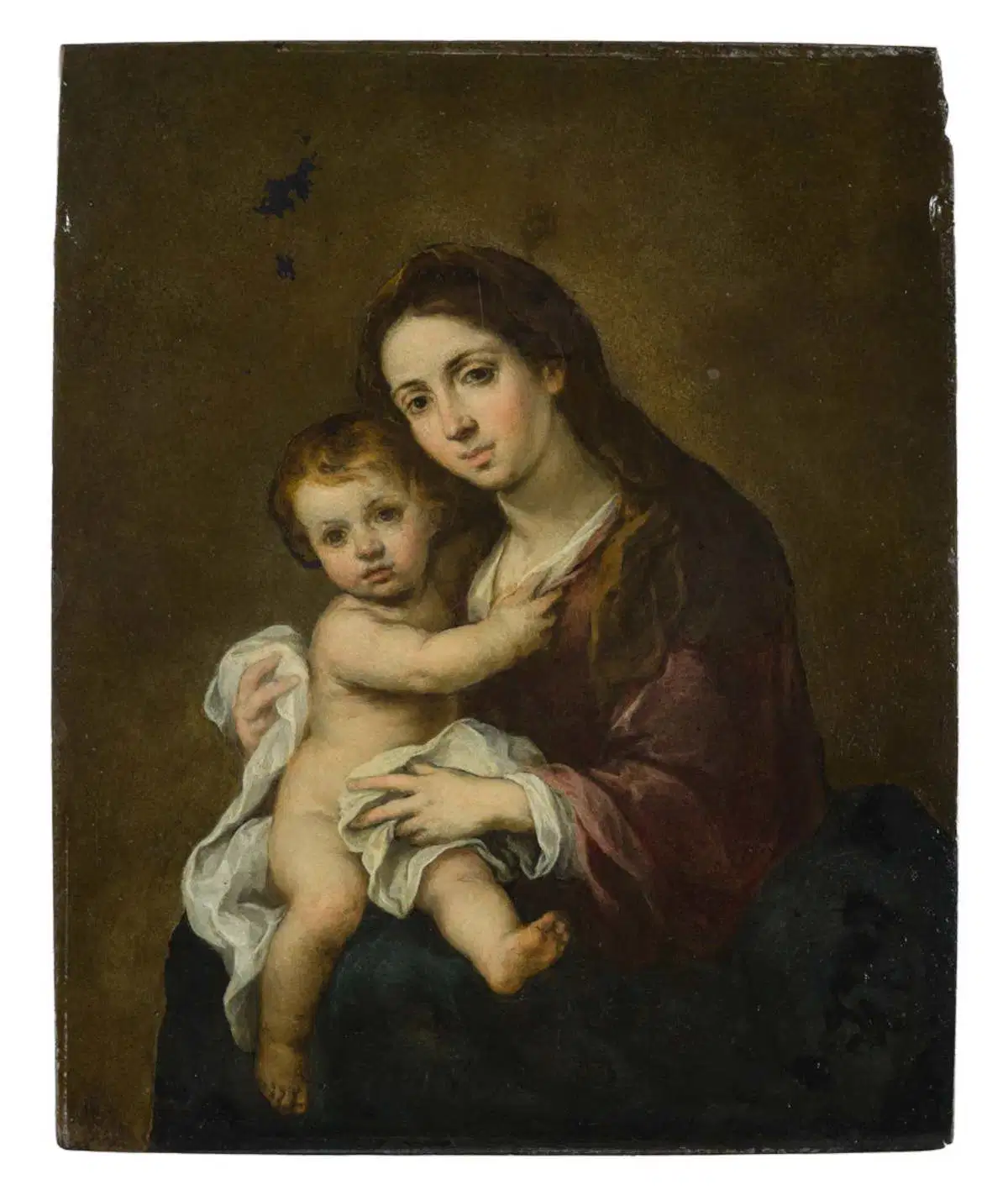
The first surprise about the Madonna and Child offered at im Kinsky in Vienna on 11 November was what it was painted on. The second was the price. Catalogued as “Circle of Bartolome Esteban Murillo” and estimated at €5,000–€10,000, the little painting went for €220,000 at the hammer, or €286,000 including fees and Austrian VAT. The auction catalogue gave its provenance in three words: “private property, Vienna”. On the other side of that modest entry lies the possibility of a rather grander history.
The painting is in oil on obsidian, a dark volcanic glass that Murillo used for a handful of devotional pictures. The Louvre has two, Christ in the Garden of Olives and Christ at the Column with Saint Peter. Over the centuries their supports were variously described as black stone, black jasper and marble. Scientific examination in 2000–01 established that both were obsidian. Those old descriptions, imprecise as they were, turn out to be useful clues.
The Spanish art historian Pablo Hereza proposes that the Vienna picture is by Murillo himself and that it is the Madonna on black marble recorded in Sir Robert Walpole’s collection in 1752. According to ARS Magazine, it was a gift from Sir Benjamin Keene, the British ambassador to Spain. The measurements are unusually close: 30.5 × 25 cm for the Vienna picture, against 30.4 × 24.3 cm in the historical inventory. Madonnas in Murillo’s manner are plentiful. A Madonna on a dark, glassy support that so nearly matches the dimensions of a documented picture is a more interesting coincidence.
The Walpole picture went to Russia with Catherine II’s purchase of the collection in 1779. ARS traces it from the Hermitage to Gatchina and later to Pavlovsk, after which the trail goes cold. The Vienna catalogue offers nothing to bridge that gap. Hereza’s proposal therefore raises two questions: whether the surviving picture is the one in Walpole’s inventory, and whether Murillo painted it. The rare support and the measurements give the first question some purchase. The second will depend more on what can be read in the painting itself.
That may take some time. ARS reports visible repainting, and a conservator’s examination could clarify how much original paint survives and where it can be judged. The Louvre pictures offer a useful point of comparison: how did Murillo handle oil on this unusually smooth surface, and how much of the dark glass did he allow to show through?
The hammer price was 22 times the upper estimate. It is easy to see why the picture attracted that sort of bidding: few lots at €5,000–€10,000 come with a question this specific. Somewhere between Walpole’s “black marble” and the obsidian in the Vienna catalogue may lie a missing painting. Whether it is also a lost Murillo is the question that makes it worth looking at closely.