Hepworth’s Winged Figure comes to auction in Cornwall and New Zealand
One was given to the sculptor’s doctor; the other was acquired by a young New Zealander who befriended her in St Ives. Both belong to the story of the figure above Oxford Street.
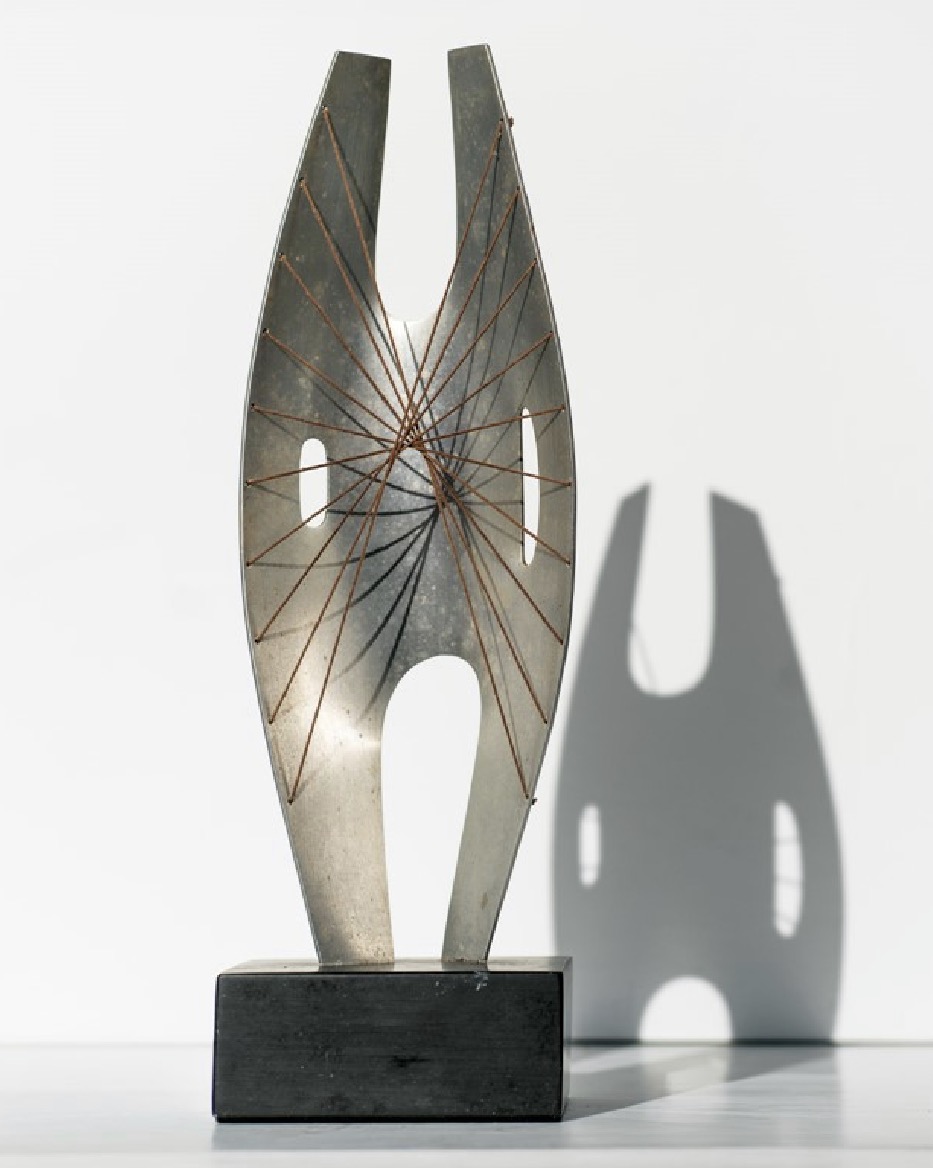
On the Holles Street side of John Lewis, two aluminium wings curve away from the wall. Slender steel rods cross the space between them, pulling the eye in several directions at once. Barbara Hepworth wanted the sculpture to evoke the freedom of moving through air or water. At nearly six metres high, it is a work Londoners tend to see in passing, from the pavement below. This month, two much smaller versions are coming to auction, one in Penzance and the other in Auckland.
The Cornish work was a gift from Hepworth to her doctor. The Antiques Trade Gazette describes it as a 33 cm aluminium-and-string maquette and suggests it could fetch £80,000. Lay’s public preview confirms that its Penzance fine-art sale runs on 26-27 November, but does not yet list the Hepworth. Its date, edition details and full estimate remain unconfirmed.
The Auckland sculpture is more fully documented. Webb’s catalogues it as a Miniature of Winged Figure of 1967, in aluminium and strings on black marble, from an edition of nine plus one prototype. The owner, who acquired it directly from Hepworth, had come to Britain from New Zealand in the 1960s and found front-of-house work at a St Ives restaurant where she was a regular. Their friendship is at the heart of the collection now being offered. The miniature is lot 44 in the 23 November sale, estimated at NZ$140,000-180,000 before buyer’s premium.
The dates matter because Winged Figure was a form Hepworth returned to at different scales. The John Lewis commission grew out of Winged Figure I of 1957, after the company turned down her first proposal, Three Forms in Echelon. She and her assistants worked on the enlargement at the Palais de Danse in St Ives, and the finished sculpture was installed in London in April 1963. The Auckland miniature dates from four years after that installation. Until the Cornwall lot is catalogued in full, it would be premature to place it among the preparatory works for the commission.
On Oxford Street, the rods are fine lines against a building. On the Auckland miniature, the strings are close enough for the eye to follow individually, from the edge of one wing to the other. The sculpture still depends on the space they cross. At this scale, a viewer can move around it and see that space change.