An early Hepworth in alabaster at Osborne Samuel
At just 19cm high, Barbara Hepworth’s Figure of 1933 might seem an unlikely work to hold its own in a company of celebrated British sculptors.
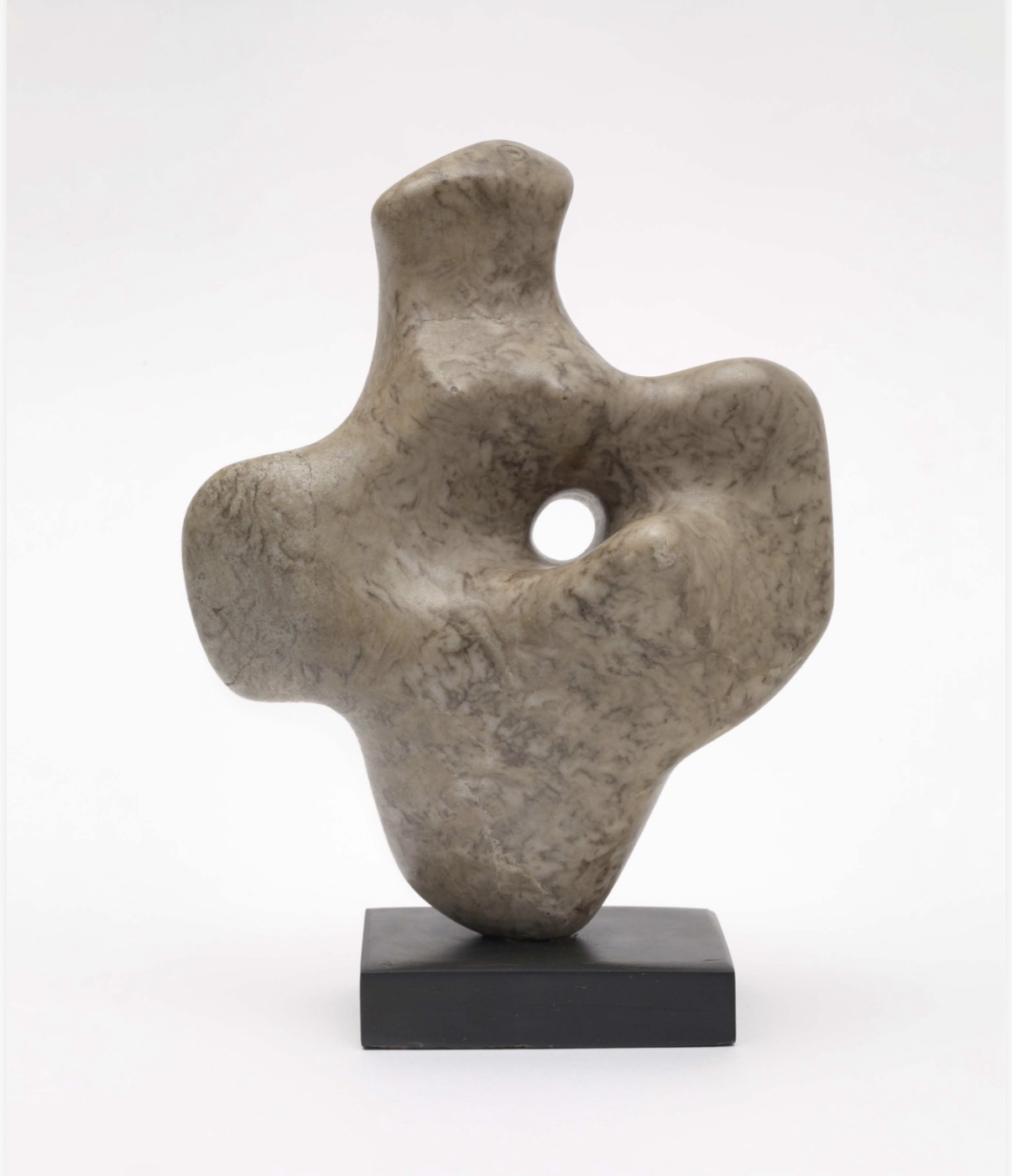
Yet this small carving in grey alabaster gives Osborne Samuel’s Five British Sculptors much of its historical interest. Made three decades before the film that inspired the exhibition, it catches Hepworth working out how far she could transform the human body while retaining its presence.
The figure has an almost disconcerting physicality. A small head rises from a broad, uneven body, its surface clouded with the stone’s darker markings. Tiny incisions indicate the breasts; a circle and dot suggest an eye. The outline swells and narrows without quite settling into familiar anatomy. Below the breasts, a hole passes through the stone, drawing the eye into a form that seems at once weighty and remarkably supple.
The body is compressed, its proportions freely rearranged, but it retains a warmth that makes the desire to hold it entirely understandable. The opening gathers the surrounding curves towards it, giving the carving an internal focus as well as a silhouette. Even at this intimate scale, Hepworth makes the space within the sculpture as compelling as the stone itself.
Figure belongs to the years Hepworth spent in Hampstead, before her move to St Ives in 1939. Since 1932 she had shared a studio with Ben Nicholson at 7 The Mall, and the sculpture appeared, under the title Composition, in their joint exhibition at Alex Reid & Lefevre in 1933. Judith LeGrove, whose essays accompany the present show, draws attention to the circles and dots that connect its lightly inscribed features with Nicholson’s pictorial language. The exchange between painting and sculpture is there in the smallest marks on the stone.
The material brings another relationship into view. Cumberland alabaster is quite unlike the milky, translucent stone usually suggested by the name. Its greys and browns are opaque and mottled, giving a carved surface a density that can seem closer to a pebble than a precious mineral. Around 1930, John Skeaping acquired pieces uncovered by a farmer and shared the source with Hepworth and Henry Moore. Both sculptors made use of it.
Osborne Samuel also includes Moore’s Head of 1931, a carving only 15.2cm high including its base. LeGrove suggests that it and Hepworth’s Figure probably came from the same source of stone. Their presence in the same exhibition offers a particularly intimate way of considering two artists so often discussed through their monumental public works: small blocks, closely worked, with the character of the material immediately apparent.
Moore later recalled becoming dissatisfied with alabaster because admirers could become so absorbed in its beauty that they overlooked the sculpture. In Hepworth’s Figure, the mottling and the carving seem harder to disentangle. The stone lends the body its irregular complexion, while the carved hollows give those natural markings a new setting. Its appeal lies partly in the difficulty of deciding where one’s attention rests.
The provenance begins with Cyril S. Reddihough, followed by a private British collection. Although privately owned, the sculpture has a substantial exhibition history, including Hepworth’s Whitechapel retrospective in 1954 and Tate’s Barbara Hepworth: Sculpture for a Modern World in 2015. Its inclusion here offers another opportunity to look closely at an early work whose modest dimensions belie its ambition.
The exhibition’s starting point is Warren Forma’s 1964 documentary 5 British Sculptors Work and Talk, which followed Kenneth Armitage, Reg Butler, Lynn Chadwick, Hepworth and Moore in their studios. Curated by Tania Sutton, the show was presented at Frieze Masters before opening in Cork Street, where the film is also being screened. Forma’s attention to the practical business of making provides a welcome thread through such different bodies of work.
Hepworth was especially pleased with his film. LeGrove’s research into their correspondence reveals an affectionate friendship and a filmmaker fascinated by the tactile possibilities of her sculpture. His camera followed the rhythm of her carving and the movement of her hands over finished forms. Seen against that later account of a sculptor thoroughly at ease with her methods, the little alabaster acquires an added fascination. Thirty years earlier, the relationship between hand, stone and the space cut through it was already taking shape.
Five British Sculptors, Osborne Samuel 21 Cork Street, London, 22 October-20 November 2026.