Hepworth’s Sculpture with Colour (Eos) returns to auction following landmark Courtauld exhibition
Barbara Hepworth’s remarkable 1946 stone carving, Sculpture with Colour (Eos), is returning to Christie’s a decade after achieving $5.43 million in New York. Recently exhibited in the Courtauld Gallery’s acclaimed Hepworth in Colour exhibition, the work will be among the highlights of Christie’s Modern British and Irish Art Evening Sale in London on 21 October 2026.
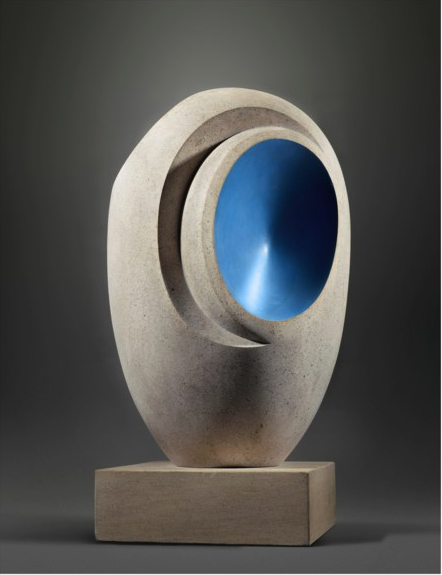
Few works better illustrate Barbara Hepworth’s extraordinary ability to combine the physical qualities of carved stone with the seemingly infinite possibilities of colour and space than 'Sculpture with Colour (Eos)' (1946). Its reappearance at auction comes at a particularly interesting moment, just weeks after the conclusion of the Courtauld Gallery’s exhibition devoted to one of the most important, yet historically underexplored, aspects of the artist’s practice.
The exhibition, which ran from 12 June to 6 September 2026, brought together Hepworth’s pioneering painted sculptures of the 1940s, many reunited for the first time in decades. Among its most significant loans was Eos, lent from a private collection in Hong Kong and exhibited alongside Eidos (1947-48), now in the National Gallery of Victoria, Melbourne. The two sculptures were shown together in Britain for the first time since 1954.
Carved from Hopton Wood stone in 1946, Eos stands just 59.1 centimetres high, excluding its base. Its smooth, upright ovoid form is interrupted by a sequence of deeply carved hollows, the most striking containing an intense blue interior. The apparent simplicity of its external form conceals a remarkably complex interplay of curves, shadows and colour.
The blue recess seems almost to recede beyond the physical limits of the sculpture, creating an illusion of depth that contrasts with the solidity of the surrounding stone. It is a particularly compelling demonstration of Hepworth's conviction that colour could actively transform the sculptural experience rather than merely decorate its surface.
The title refers to Eos, the Greek goddess of the dawn, an association explored in the recent Courtauld exhibition catalogue. The contrasting tones of blue and pale grey suggest the changing colours of the sky at daybreak, while the subtle gradations within the painted hollow introduce an almost atmospheric quality.
As the catalogue explains, Hepworth’s interest extended to the emotional associations of colour, particularly the relationship between landscape, light and the experience of being within nature. The artist herself associated the coloured interiors of her sculptures with the depths of water, caves and shadows, sensations that had become central to her artistic development following her move to Cornwall in 1939.
There is also a strong connection with the recurring oval and egg-like forms found throughout Hepworth’s work. The sculpture has previously been linked to themes of maternity, gestation and nurture, although its significance extends considerably beyond such interpretations. For Hepworth, the oval remained a form of almost inexhaustible sculptural possibility, one that allowed her to explore the relationships between interior and exterior, mass and emptiness, and the human figure within the landscape.
The sculpture last appeared at auction at Christie’s New York on 12 May 2016, when it was offered from the celebrated collection of David and Geraldine Pincus.
Estimated at $1.2 million to $1.8 million, it achieved $5,429,000 including fees, more than three times its high estimate and a remarkable result for a relatively modestly sized stone carving.
The work had been acquired by the Pincuses from Martha Jackson Gallery, New York, on 1 November 1962, remaining in their collection for more than half a century. Before that, its distinguished exhibition history included Hepworth’s 1946 exhibition at the Lefevre Gallery, the Whitechapel Art Gallery retrospective of 1954, the Tate retrospective of 1968 and the centenary exhibition at Tate St Ives in 2003.
Its recent appearance at the Courtauld adds another important chapter to that history and provides a fresh scholarly context for its return to the market.
The exhibition challenged the familiar understanding of Hepworth as a sculptor concerned principally with the inherent qualities of her materials. Instead, it demonstrated how central colour had been to her conception of sculptural form, particularly during the extraordinarily inventive years of the 1940s.
For collectors, Eos therefore offers an unusual combination of qualities: a unique carving from a formative period in Hepworth’s career, a substantial exhibition and publication history, a firmly established auction record and renewed institutional attention.
The question now is whether the sculpture's recent prominence at the Courtauld will translate into renewed competition in the saleroom.
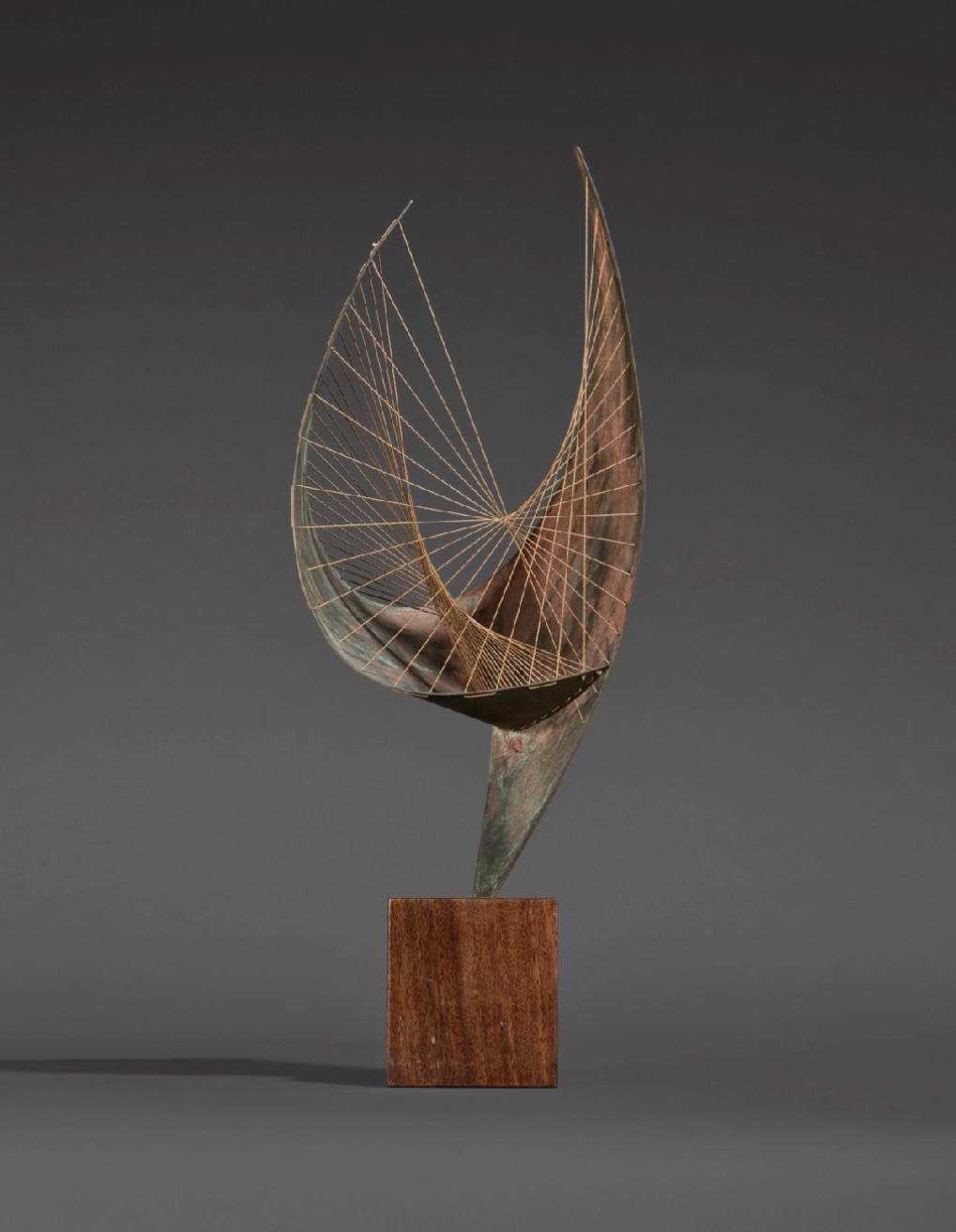
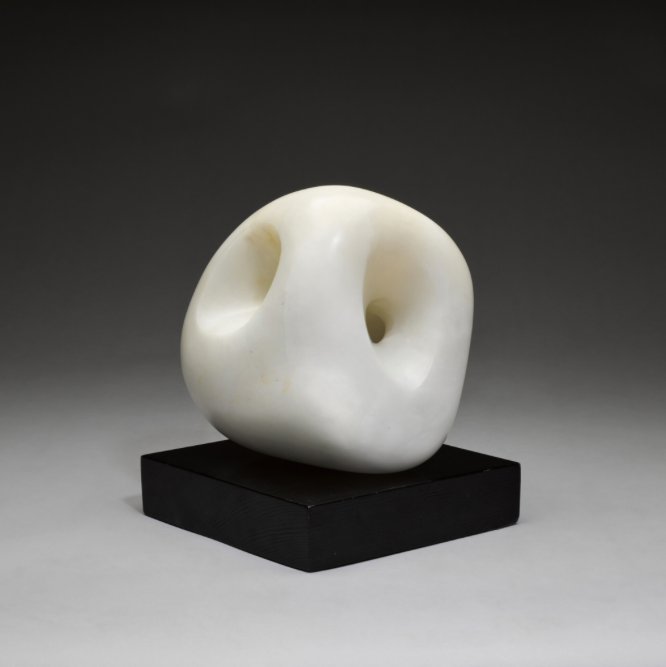
Christie’s Modern British and Irish Art Evening Sale on 21 October will feature no fewer than three major Hepworth sculptures - made from stone, brass & elm - and also a major 1950s work by Ben Nicholson.