A shouting Demosthenes and another improbable Caravaggio
A new attribution assembles documents, poetry and technical evidence around a privately owned painting. The difficulty begins when one looks at the picture.…
Updated
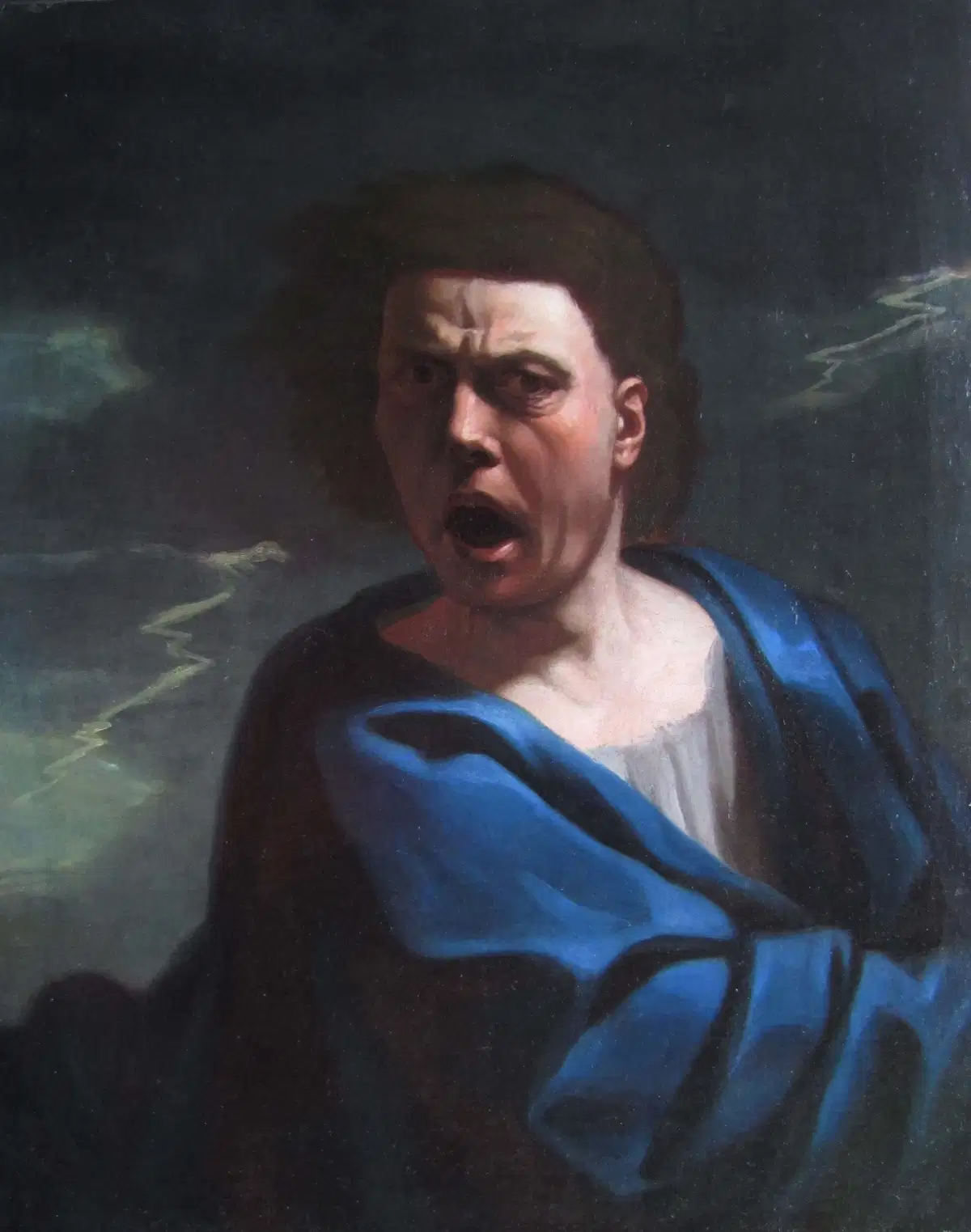
October is an odd month for an April Fool. Yet the latest painting proposed as a lost Caravaggio does invite a glance at the calendar. A man wrapped in brilliant blue drapery opens his mouth against a stormy sky, with lightning obligingly supplying the drama. On the published photograph, the attribution is very difficult to take seriously.
Caravaggio’s latest proposed rediscovery arrives with a thunderstorm, a shouting man in a brilliant blue cloak and enough supporting scholarship to fill a book.
The painting is the subject of L’Urlo di Caravaggio, a new volume by Carmelo Occhipinti, with contributions from Michele Frazzi and the dealer Mario Bigetti, published by UniversItalia in the Horti Hesperidum series. Its authors believe they have found Caravaggio’s lost parlatore togato, an orator in a toga once owned by Onorio Longhi, and identify the figure as Demosthenes. The privately owned canvas, measuring 76 × 61cm, is dated by them to around 1597-1602.
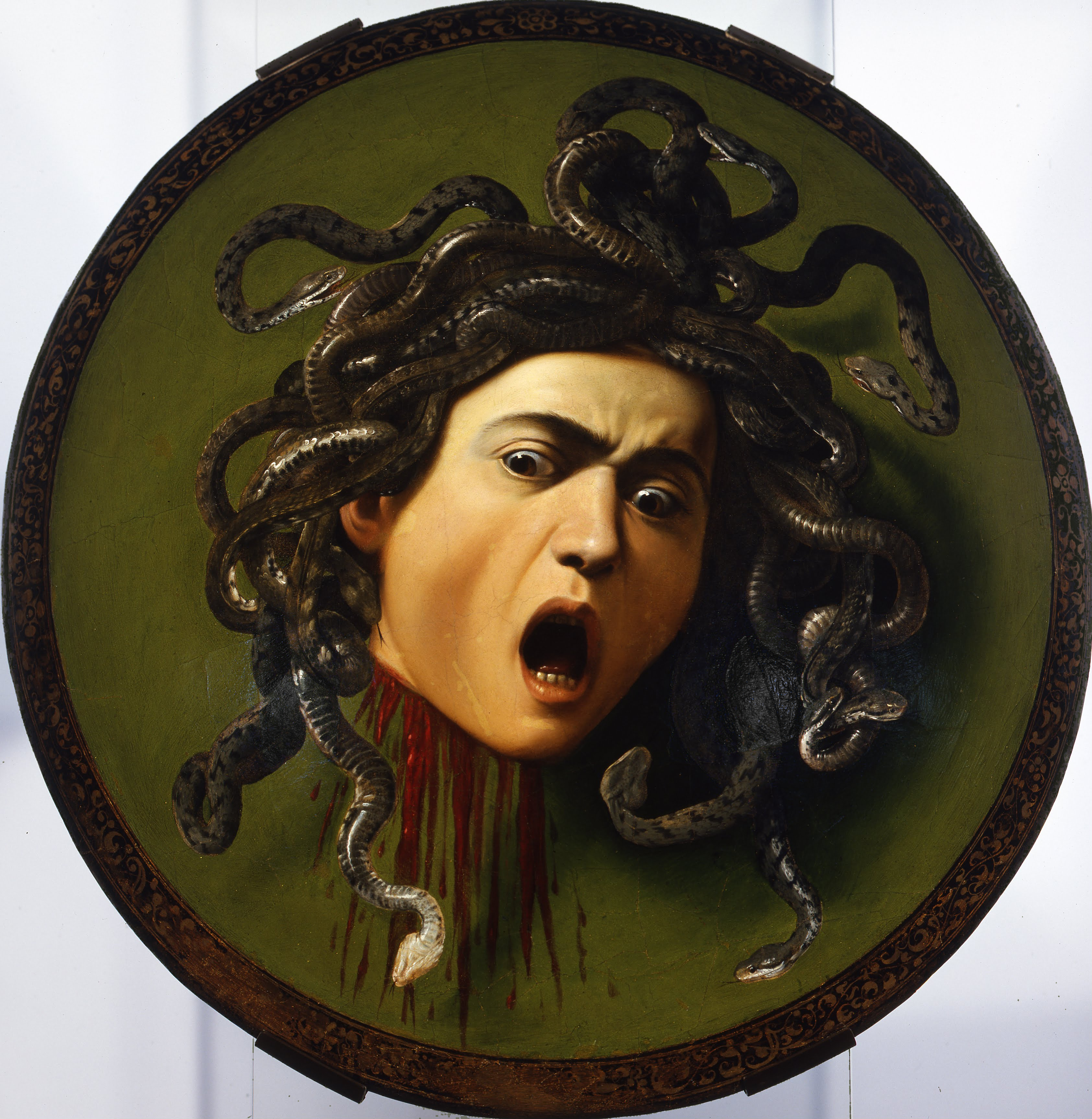
As revealed by Finestre sull’Arte on 26 October, their Demosthenes is certainly making an effort. His forehead buckles, his eyes strain and his mouth forms a dark oval in what looks like a laboured pastiche of Caravaggio’s Medusa. The blue drapery falls across his chest in hard, moulded folds, while lightning zigzags through the background. Everything announces drama, yet the figure remains curiously inert. Caravaggio could make a sudden movement feel as though it had interrupted the act of looking. This man seems to have been holding his expression for some time.
The authors have, nevertheless, assembled a substantial case. A 1652 inventory of the Longhi collection records an orator attributed to Caravaggio, and the documentary trail runs cold after 1660. It is an enticing reference, offering both a missing work and a subject that might accommodate the present picture. The difficulty is getting from that seventeenth-century entry to this particular canvas. No connecting ownership history emerges from the published account, leaving several centuries to be crossed largely on the strength of a resemblance to the description.
Frazzi brings Marino into the discussion, linking the storm to madrigals in the poet’s La Galeria of 1620. He also finds visual precedents in Michelangelo and the Cavalier d’Arpino, and affinities with Caravaggio’s ‘Boy Bitten by a Lizard’. Such connections may help explain the painter’s sources, or make a persuasive case for calling his subject Demosthenes. They are less helpful in establishing who held the brush. The distance between recognising a literary subject and recovering the very painting a poet described remains considerable.
Bigetti approaches the problem through the familiar apparatus of attribution: incisions, pentimenti, pigments, preparation and canvas weave. He argues that these are consistent with Caravaggio’s practice and that the radiographs possess qualities distinctive of the artist. There is useful material here, but the familiar slippage from compatibility to certainty needs watching. A revised shoulder or an altered mouth tells us that an artist changed his mind. Appropriate pigments may support a date. Neither gets us very far towards Caravaggio without a convincing account of the handling, and the claim that his authorship can be distinguished radiographically needs scrutiny of its own.
In Occhipinti’s introduction, the argument becomes more lyrical. Demosthenes, struggling to make himself heard above the storm, becomes a counterpart to Caravaggio giving painting its voice. Breath turns into a cry; the orator’s defiance of nature echoes the painter’s ambition. It is an appealing conceit, although by this point the attribution has slipped quietly from the proposition under examination into the premise on which everything else depends.
Part of the enduring appeal of these discoveries is that they occasionally prove true. When Sergio Benedetti encountered ‘The Taking of Christ’ in a Dublin Jesuit house in 1990, he recognised what turned out to be a masterpiece. Three years of research, conservation and consultation followed before its unveiling in 1993. The possibility of repeating such a discovery is enough to keep scholars and dealers looking, and rightly so.
The ‘Ecce Homo’ that surfaced in Madrid in 2021 offered a more recent encouragement. It won the backing of the Prado and several leading specialists, while continuing to attract dissent when exhibited in 2024. The arguments around it also showed how much can remain contested after a painting has acquired a prestigious setting and a confident label.
Then there is the name itself. Caravaggio can transform the prospects of a picture, commercially and intellectually, in a way that few artists can match. An anonymous Italian painting may interest a handful of specialists; a possible Caravaggio commands an international audience before the argument has properly begun. For an owner, a scholar or a dealer, the attraction is obvious. Conviction can be entirely sincere and still encourage a habit of treating every resemblance as confirmation and every awkward passage as something to be explained away.
The press has its own reasons to enjoy the chase. A lost masterpiece, an archival clue and an X-ray make a far better story than an unresolved attribution to an unidentified painter. By the time the slower work of comparison and disagreement gets under way, the rediscovery has already had its headline. Even a carefully placed question mark does little to diminish the force of the famous name.
That leaves the painting itself, which deserves to be considered without the burden of becoming a Caravaggio. Its subject and sources may yet yield an interesting history. For the moment, though, the scholarship has supplied a much more impressive performance than the painter. Demosthenes is shouting, but the attribution remains unpersuasive.