A Crayfish, a Beam of Light and the Pensionante del Saraceni - An anonymous painter emerging from the shadows
Very, very slow to this but 'new' attribution to Pensionante del Saraceni seems entirely convincing. A striking Caravaggesque painting now with Colnaghi invites a fresh look at one of the most elusive painters of early seventeenth-century Rome - and at just how closely he may have understood Caravaggio's art.
Updated
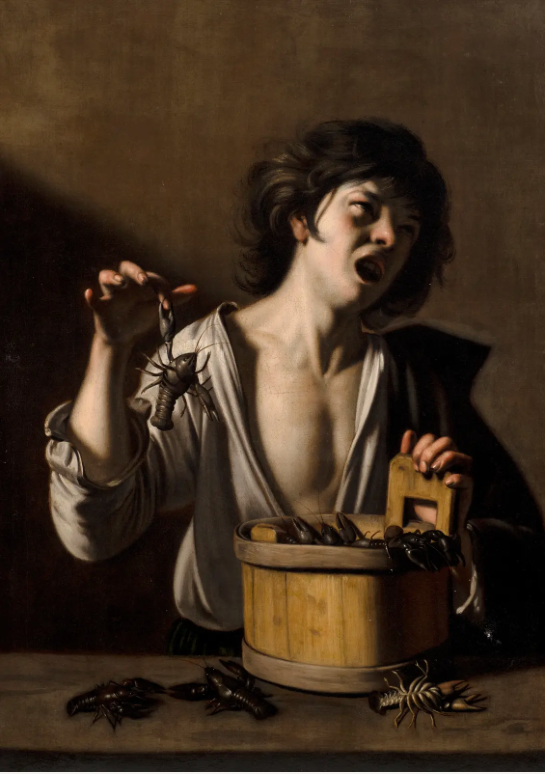
A young man jerks backwards, mouth open in pain, as a freshwater crayfish hangs from his finger. Before him sits a wooden tub filled with more of the creatures, while several others have escaped across the ledge in the foreground. It is an image that belongs unmistakably to the world created by Caravaggio: ordinary life transformed into drama by an instantaneous gesture, an unexpected shock and a carefully controlled fall of light.
The painting, A Boy Being Bitten by a Freshwater Crayfish, is currently presented by Colnaghi as a work by the still unidentified artist known as the Pensionante del Saraceni. Measuring 102.2 by 79.1 cm, it was formerly in the collection of Giancarlo Baroni and appeared at Sotheby's in New York in January 2013, already under the Pensionante's name. Colnaghi describes it as arguably the finest surviving version of a composition known through several other examples.
The name Pensionante del Saraceni was invented by Roberto Longhi in 1943 for an anonymous painter whose works appeared to combine the influence of Caravaggio with that of Carlo Saraceni. "Pensionante" means approximately lodger or boarder, reflecting the possibility that the painter may have belonged to the group of artists who lived or worked around Saraceni in Rome.
Attempts to identify him have produced a procession of candidates, among them Jean Le Clerc, Guy François, François Walschartz and Jacob van Oost the Elder. None has proved convincing. What has emerged instead is a small stylistic corpus - paintings characterised by a subdued, unusually atmospheric light, an often cool tonality, quietly observed gestures and, importantly, an exceptional interest in still life.
That last characteristic may be particularly important here. Look past the young man's theatrical cry and the painting becomes almost a still life with a figure attached. The crayfish scattered across the ledge are observed individually. Their articulated shells, antennae and claws are crisply differentiated, as are the wooden staves, hoops and handle of the tub. They are not generic accessories introduced merely to explain the narrative.
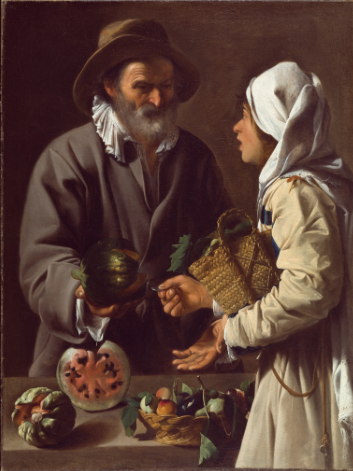
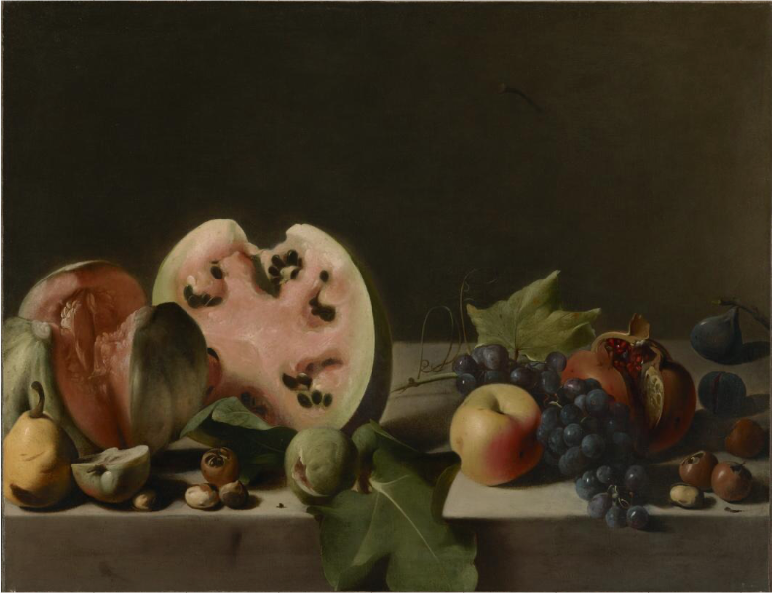
The Pensionante repeatedly seems at his most confident when painting things. This quality is evident in the celebrated Fruit Vendor in the Detroit Institute of Arts and, still more clearly, in the independent still lifes associated with him. In 2025 the Kimbell Art Museum acquired his remarkable Still Life with Melon, Watermelon and Other Fruits, praising the painter's combination of intense realism with soft, enveloping light. The Pensionante can make objects extraordinarily present while avoiding the hard, almost metallic illumination found in some other Caravaggesque painters.
The same contradiction occurs in the crayfish picture. The objects are sharply understood, yet the atmosphere surrounding them is surprisingly gentle. Look at the hands. There is another detail that seems particularly persuasive: the hands. Compare the boy's raised hand with the hands in the Detroit Fruit Vendor. The fingers have a slightly feathered quality at their extremities. They do not have the sculptural hardness that one might expect from a straightforward imitator of Caravaggio. Highlights slip softly across the fingers and knuckles, while their contours seem to dissolve fractionally into the surrounding air.
It is a small characteristic, but these are precisely the kinds of details upon which convincing attributions often depend. The second hand, resting on the handle of the tub, is equally revealing. It does not perform a grand rhetorical gesture. It simply grips. This mixture of slightly awkward anatomy and acute observation is familiar from other paintings associated with the Pensionante, whose figures can sometimes appear less assured than the still-life passages surrounding them.
Caravaggio reversed. There is, however, another aspect of the painting that deserves attention and which may provide an intriguing connection with Caravaggio himself. The obvious prototype is Boy Bitten by a Lizard, painted by Caravaggio around 1594-95 and now in the National Gallery, London. There too an attractive young model recoils at the exact instant an unseen danger hidden among objects on a table becomes painfully real. Caravaggio's picture proved enormously influential, and numerous seventeenth-century copies and derivations are known.
![Caravaggio, Calling of Saint Matthew [1599] Contarelli Chapel San Luigi Dei Francesi Rome](https://arthistory.news/media/editor/a620a08a-d529-418b-896c-b9d9eb3e3d34/b72144c0-0c69-bc60-79a7-8c81bfdee711.png)
But the relationship between the two pictures may extend beyond subject matter. Look at the wall behind the figures. In Boy Bitten by a Lizard, light and shadow divide the otherwise empty background diagonally. In A Boy Being Bitten by a Freshwater Crayfish, the effect appears almost to have been inverted. The broad diagonal wedge across the wall runs in the opposite visual direction, like a recollection of Caravaggio's lighting arrangement seen in reverse.
That may be more significant than it first appears. Caravaggio's contemporaries specifically remarked upon his unusual use of concentrated illumination from above. Giulio Mancini compared the effect to a room illuminated through a single high window, producing exceptionally bright lights and deep shadows. Modern scholars have rightly cautioned against taking Mancini's description literally as a blueprint of Caravaggio's studio, but the deliberate manipulation of directional light remains fundamental to his pictorial language.
And the great culmination of that idea is visible in The Calling of Saint Matthew, where a vast diagonal band of light cuts across the rear wall of the room. The rectangular shutter and window in the Calling make the physical manipulation of light itself part of the painting's architecture. The beam is simultaneously something credible within a room and something dramatically artificial.
Seen beside these paintings, the background of the crayfish picture begins to look less like generic Caravaggesque chiaroscuro and more like an artist consciously experimenting with Caravaggio's grammar of light. The painter has not merely borrowed the screaming boy. He appears to have understood how Caravaggio constructed the room around him.
Was there once a Caravaggio? The question becomes still more intriguing because the composition survives in numerous versions. The best known is in the Musée des Beaux-Arts in Strasbourg. It has travelled through a remarkable sequence of attributions - Mattia Preti, Serodine, a follower of Caravaggio, a French Caravaggesque painter, an anonymous Roman master and, more recently, an attribution to the Pensionante del Saraceni. Other versions are recorded in Lyon, Milan and historic collections in Rome and Geneva. Their number suggests that the composition itself enjoyed considerable contemporary fame. That led Jean-Pierre Cuzin and Pierre Rosenberg to wonder whether all of them ultimately descended from a lost Caravaggio.
There is a tantalising piece of seventeenth-century evidence. In his 1650 description of the Villa Borghese, Jacomo Manilli recorded a small painting of a boy bitten by a crab as by Caravaggio. No corresponding painting appears in the surviving seventeenth-century Borghese inventories, however, and the animal depicted in the surviving compositions is clearly a freshwater crayfish rather than a crab. The reference is therefore intriguing rather than conclusive.
Perhaps a lost Caravaggio lies somewhere behind the composition. Perhaps not. But that may be the wrong question. What matters for the present painting is whether its particular handling belongs to the painter we call the Pensionante del Saraceni. Here the accumulation of evidence becomes impressive: the cool and unusually soft tonality, the feathery treatment of the hands, the peculiar mixture of slightly uncertain figure painting and remarkably assured still life, and the sophisticated understanding of Caravaggio's directional light. Together, they make it difficult to dismiss.
The Pensionante del Saraceni remains one of the most tantalising personalities in the generation immediately following Caravaggio - a painter whose name has disappeared even as a remarkably distinctive visual personality has gradually been reconstructed from the pictures themselves. A Boy Being Bitten by a Freshwater Crayfish may help bring that personality a little further into the light.
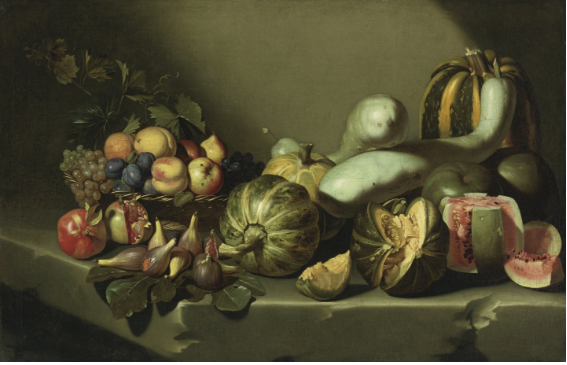
All this does remind one of another tantalising attributional challenge - the masterpiece once sold as Roman School c.1605-10 at Sotheby's - its clear its not by Pensionante, but was Spike right all along - is it actually by Caravaggio?