The Whitney’s de Kooning goes back on the market
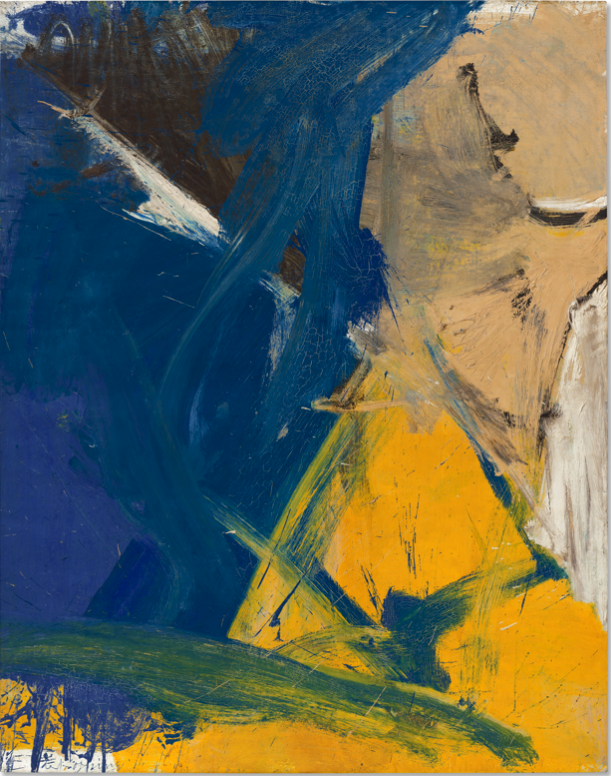
For a time, Willem de Kooning’s Yellow River hung at the foot of David Solinger’s bed. The New York lawyer and collector, who went on to become the first president of the Whitney Museum of American Art from outside its founding family, could see it as soon as he woke. His family gave the painting to the Whitney in his honour. On 17 November, just three years after formally receiving it, the museum will offer it at Christie’s in New York, with an estimate of $12m to $18m.
Painted in 1958, Yellow River is a broad sweep of blue and yellow, with enough of the world outside the studio in it to make the title feel apt without quite telling us what we are looking at. It appeared in de Kooning’s 1959 show at Sidney Janis Gallery, when the painter was moving away from the figures that had made him famous towards a looser kind of landscape. Solinger bought it from the gallery that October. After his death it passed to his widow, Betty Ann Besch Solinger, who promised it to the Whitney in 2011. The museum showed the picture in Singular Visions while it was still a promised gift; ownership passed in 2023.
There is a plausible case for selling from a position of strength. The Whitney has several substantial de Koonings, among them Door to the River, painted two years later and bought by the museum in 1960. The two pictures belong to the same change in his work, though they make quite different things of it. The earlier canvas sends colour sweeping across the surface; in the later one, broad strokes gather around a pale, almost architectural opening. A museum with both can show how quickly de Kooning found different possibilities in the same turn towards landscape.
The Whitney told Artnet News that the sale forms part of its long-term plan to strengthen and expand the collection. There is some substance behind that explanation. Its 2023 collection strategy argues for selling selectively where the holdings are already deep, both to make purchases and to build an acquisitions endowment. Christie’s says the proceeds will benefit the collection. The museum’s reported statement leaves open why this particular painting was chosen and what the money will make possible.
The peculiarity of the sale is its timing. Yellow River spent twelve years as a promised gift and just three as the museum’s property. The Whitney had lived with the prospect of owning it long enough to exhibit it, and knew the rest of its de Kooning holdings when it took title. On Tuesday, bidders will put a price on the picture. The more interesting account will be the one the Whitney can give of what its collection stands to gain by letting it go.