Il Guercino before the finishing touches?
A proposed early version of Erminia and Tancred comes to auction in Monaco, offering a rare look at how the young painter worked out one of his most dramatic compositions.
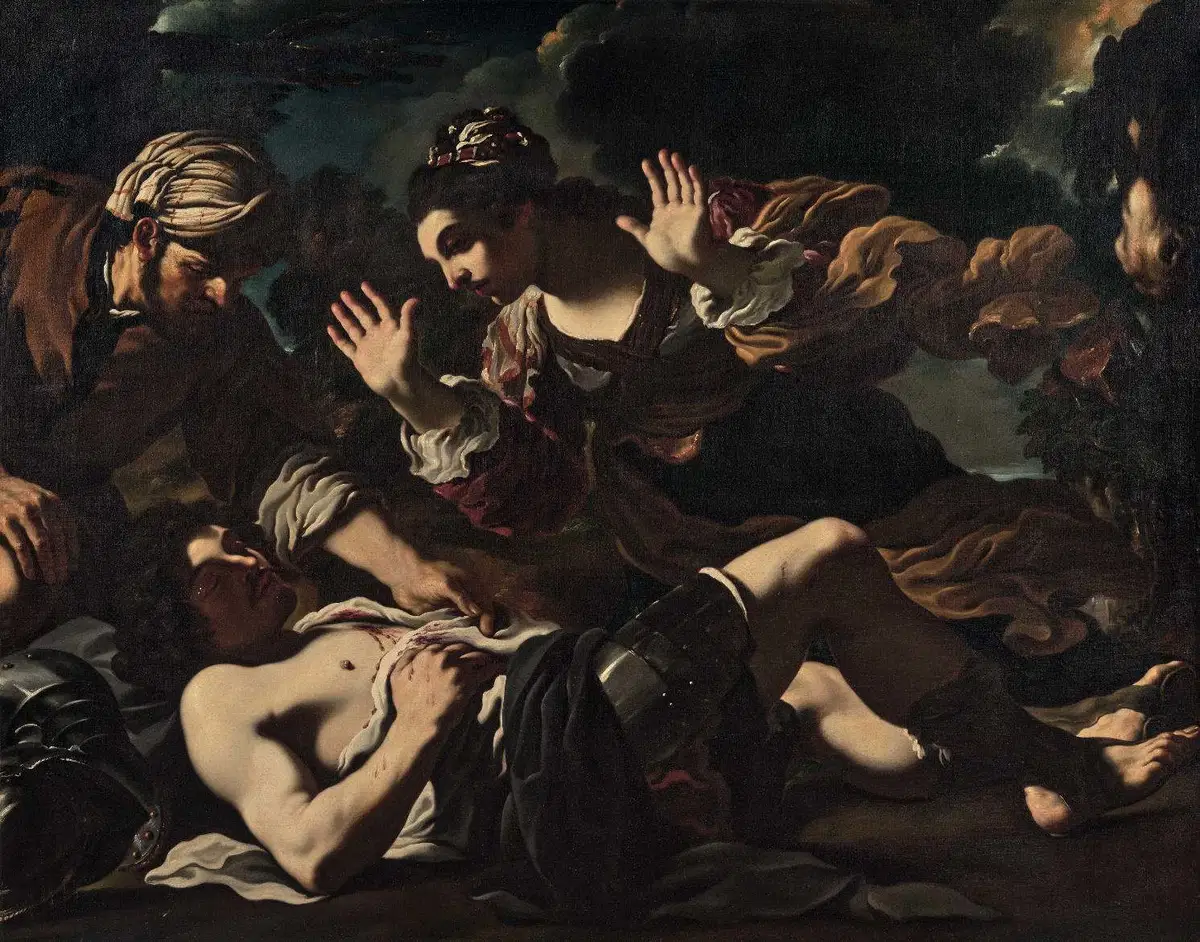
Erminia’s hand has shifted. So have the wounded Tancred’s legs. Even the horse’s ears have been reconsidered. These are small differences between two paintings nearly two metres wide, but they help explain why the Erminia Finds the Wounded Tancred coming up at Hôtel des Ventes de Monte-Carlo on 28 November is more than a second version of the picture in Rome’s Doria Pamphilj Gallery. The Guercino scholar Nicholas Turner regarded it as the painter’s first attempt at the composition, worked out at almost exactly the size of the finished canvas. The estimate is €800,000-€1.2m.
The story comes from Tasso’s Jerusalem Delivered. Erminia, a Saracen princess in love with the Christian knight Tancred, finds him gravely wounded after his duel with Argante. She will cut her hair to bind his wounds, but Guercino chooses the instant before she can do anything for him. The horse is still there, and Tancred’s squire points to the injuries. It is a scene of discovery, with the action briefly held in suspense. The Doria Pamphilj dates its painting to 1618, following the seventeenth-century biographer Carlo Cesare Malvasia, who records that Guercino painted it for the mosaicist Marcello Provenzali.
When Turner overlaid photographs of the two canvases, the figures matched in scale closely enough to suggest that one composition had been transferred from the other. The differences helped him decide which came first. In the Monaco picture, the faces are more broadly painted and the light around Erminia’s profile and neck is less developed. In the Roman canvas, those touches give her greater presence without altering the essentials of the scene. Guercino had already settled where everyone would stand and how the light would fall; he was still deciding how much each passage needed.
The sale has been reported as a rediscovery, though the picture has a longer scholarly history than that word suggests. The art historians Gian Lorenzo Mellini and Stella Rudolph bought it in the 1960s. Mellini discussed it in print in 1987, and Turner included it in his 2017 catalogue raisonné, returning to it the following year in an essay on replicas and full-scale studies. What is new is the chance to see the painting in public, at the auction preview in Monaco from 24 to 27 November and on the morning of the sale.
Seen on its own, the Monaco canvas might already look finished. It takes the picture in Rome to show how much Guercino still had in reserve. A little more light on Erminia’s neck, a different angle to Tancred’s legs: the changes are modest, but they bring us closer to the moment she realises what has happened.