Monica Poole’s dark visions of nature return to view
A piece of flint, a tangle of vegetation, the worn contours of a bone: Monica Poole found ample material for her imagination in things easily passed over on a country walk.
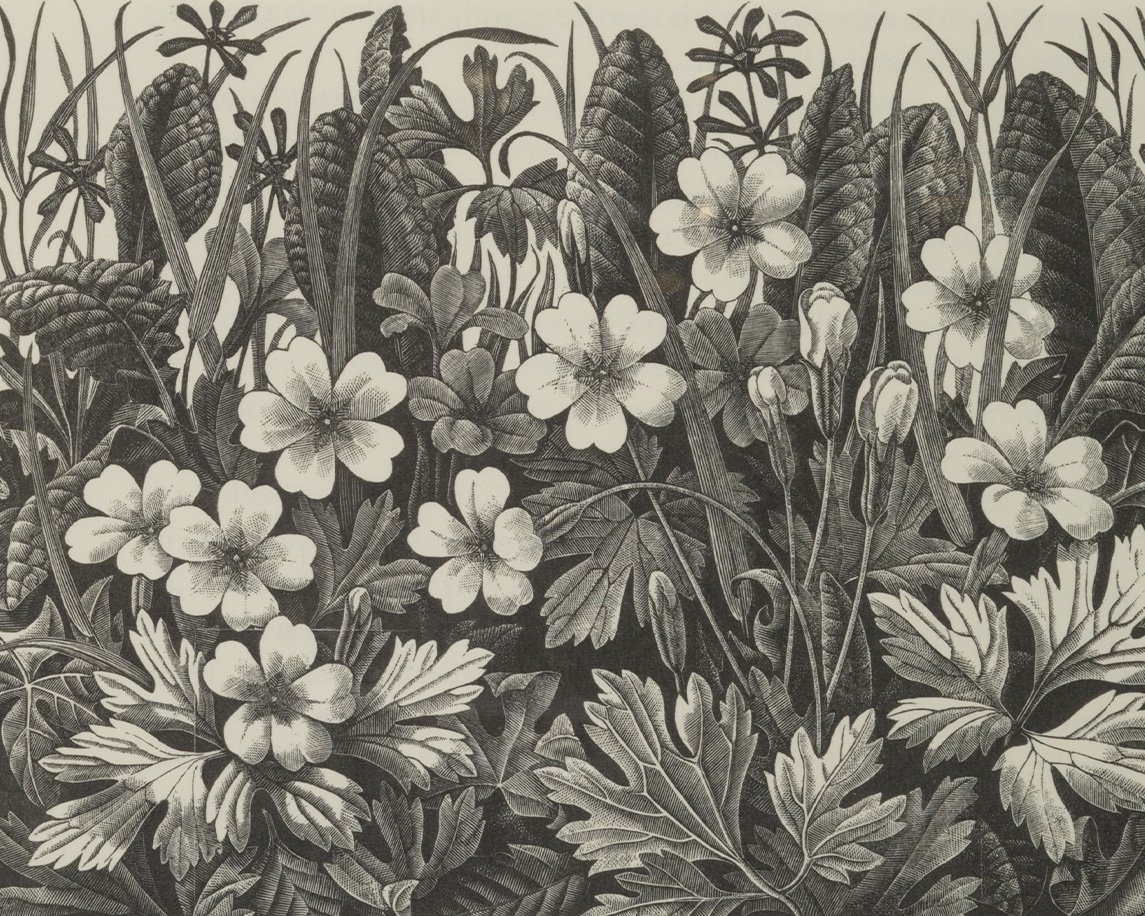
Her wood engravings belong to a tradition of close observation of the English landscape, but the world they evoke is often stranger and less reassuring than that description suggests. At Gainsborough’s House in Sudbury, a new exhibition opening on 8 November offers an opportunity to look more closely at an artist whose public profile has never quite matched the distinction of her work.
Monica Poole: Nature’s Dark Beauty brings together more than 20 engravings. The museum looks back to her 1993 Ashmolean retrospective as the last major survey, an interval long enough for a generation of visitors to have encountered her, if at all, through an occasional print. Yet her work is held by institutions including the British Museum, the Victoria and Albert Museum and the Fitzwilliam. She has an established place in collections; sustained attention has been harder to secure.
Born in Canterbury in 1921, Poole trained at Thanet School of Art before studying under John Farleigh at London’s Central School after the war. Farleigh provided a connection to the flourishing culture of British wood engraving and book illustration, and his importance to her endured: in 1985 she published a study of his engravings. Her own career developed through exhibitions and printmaking societies, with botanical subjects becoming a particular preoccupation.
The Kent landscape supplied more than scenery. Its chalk, fossils and coastal formations offered structures to be examined, isolated and transformed. The title of her 1986 engraving Chalk, Flint and Bone, now in the National Galleries of Scotland, reads almost as an inventory of her interests. These are materials shaped by growth, pressure, erosion and decay, their surfaces carrying the record of what has happened to them.
Poole’s account of her attraction to engraving was disarmingly direct. Recalling her first encounter with the tools, she wrote: “I took a look at the tools and thought ‘This is it’, I had no idea why.” She subsequently found in the medium the tonal subtlety she needed to explore form. The apparently restricted resources of black ink and white paper opened into a remarkably exacting field of enquiry.
That intimacy of scale is part of the appeal. Herbage (1979), chosen to illustrate the exhibition announcement, measures just 13 by 17 centimetres. Such dimensions ask the viewer to come nearer. A display of small engravings offers a different rhythm of looking from the sweep of a large painting exhibition: attention gathers around individual marks, textures and the relationship between light and darkness.
The exhibition’s title gives darkness its due. Poole’s place within the British landscape tradition should leave room for its more elusive possibilities, for the point at which close scrutiny makes something familiar seem unfamiliar again. Her subjects may be modest, but their treatment need not be comforting. A natural form can possess a considerable imaginative presence without acquiring a human figure or an overt narrative.
Gainsborough’s House offers a welcome occasion to reconsider the reach of that imagination. Poole requires little biographical drama or elaborate apparatus to make a claim on our attention. The engravings, and the time we give them, should be enough.
Monica Poole: Nature’s Dark Beauty, Gainsborough’s House, Sudbury, 8 November 2026-18 April 2027.