Rauschenberg’s donated Gluts bring scrap metal and dance to Tate
Three Foundation gifts anchor the ARTIST ROOMS display. One appeared in a dealer’s priced preview last year, leaving its route from commercial offer to donation unexplained.
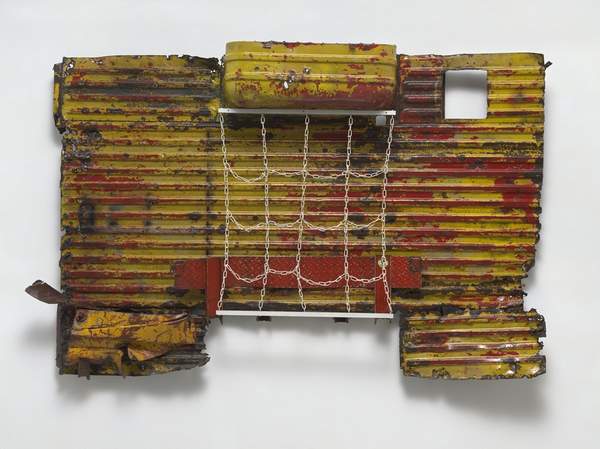
Three scrap-metal sculptures given by the Robert Rauschenberg Foundation are at the centre of Tate Modern’s new ARTIST ROOMS display. Tate’s 18 September announcement dates the free presentation from 21 September 2026 to December 2027 and lists more than 20 works. The gift was made to Tate Americas Foundation for the ARTIST ROOMS collection, jointly shared by Tate and the National Galleries of Scotland.
The donated works are G-I Glut (1986), Rasputin’s Revenge Early Winter Glut (1987) and Mobile Cluster Glut (Neapolitan) (1987). Their arrival brings together two strands of Rauschenberg’s work: his attention to industrial waste and his collaboration with dancers. Tate places the sculptures alongside paintings, prints, kinetic works and textiles, rather than isolating them as a late sculptural episode.
The Foundation traces the series’ title to Rauschenberg’s visit to Houston in 1985, after an oil surplus had caused an economic crisis. Petrol-station signs and discarded automotive and industrial components became wall reliefs and freestanding constructions. The materials retained evidence of their former purposes. In G-I Glut, Tate identifies crumpled petrol-station signage; Rasputin’s Revenge preserves the found colours and dents of its components.
The Neapolitan work has a separate performance history. According to the Foundation, Rauschenberg gathered scrap metal and fabric in Naples in 1987 to make a replacement set for Trisha Brown Dance Company’s Lateral Pass, a work dating from 1985. Parts of that set subsequently entered the Glut series. Tate’s display includes film of the Naples performance and costumes made for Brown’s Set and Reset (1983), allowing that relationship to be seen alongside the sculpture.
Writing in The Art Newspaper in July, Gareth Harris reported a statement from the Foundation’s executive director, Courtney J. Martin, who connected the gift to Rauschenberg’s concern with what society values and discards. Harris also reported Tate collection director Gregor Muir’s emphasis on access beyond the owning institutions: ARTIST ROOMS works are available to museums and galleries elsewhere in the UK. Those institutional statements explain the purpose of the gift; they are not independent assessments of the sculptures.
A public priced preview for Thaddaeus Ropac’s Paris Gluts exhibition, dated 20 October to 22 November 2025, lists Mobile Cluster Glut (Neapolitan), reference RR 1363, at US$1.6 million plus applicable taxes. That is an asking price, not a recorded sale or a valuation of the later donation. The documents checked do not explain whether the work sold, how its commercial availability ended, or whether the gallery had any role in arranging the gift. Tate identifies the Foundation as donor; no purchase price is stated.
Earlier accounts, including Harris’s July report and Ropac’s notice, gave 20 September as the opening date. Tate’s later release gives 21 September, the date followed here. It specifies December 2027 as the closing month without an exact final day.